Who Does What? A Map of Institutional Roles
A map of institutional roles helps you trace who decides, who implements and who oversees a public action, so responsibility does not vanish in the handoff.
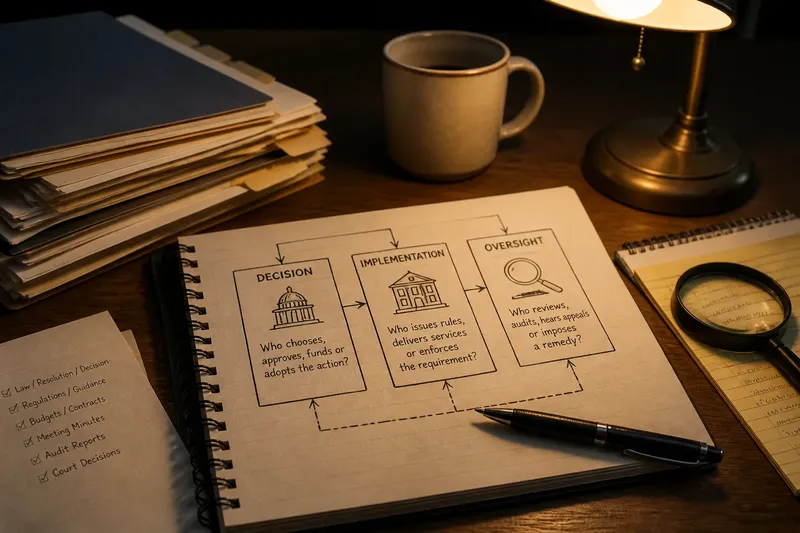
When a public agency announces a change, the announcement may come from an office that did not authorize it, and the office that authorized it may not deliver it. A map of institutional roles helps you trace who decides, who implements and who oversees a public action without treating every institution in the story as equally responsible.
The useful question is not simply, “Who is responsible?” It is: responsible for which part, under what authority, and at what point in the process? Public issues often involve a chain of bodies with distinct powers, overlapping duties and separate ways to answer for their work. Confusion usually begins when one link in that chain is mistaken for the whole chain.
Start by separating decision, implementation and oversight
These three functions are a practical first map. A decision-maker selects or authorizes a course of action. An implementing body turns that choice into rules, services, enforcement or operational work. An oversight body checks whether the decision and its execution comply with the relevant law, standards or public commitments.
The functions can sit in separate institutions, or several can belong to one institution. A legislature may authorize a program, an executive department may administer it, and an inspector general, auditor or court may scrutinize some aspect of the work. The exact arrangement depends on the issue. A label such as “agency” or “committee” tells you little until you know what authority it actually has.
Use these questions to keep the roles distinct:
- Decision: Who had authority to choose, approve, fund or formally adopt the action?
- Implementation: Who issued the operating rules, handled applications, delivered the service or enforced the requirement?
- Oversight: Who can review conduct, request records, audit performance, hear an appeal or impose a remedy?
Oversight is not one universal power. An auditor may identify accounting or management problems but lack authority to reverse a policy. A court may review whether an action is lawful without deciding whether it is wise. A legislative committee may demand explanations or propose changes, while another body retains the power to act. Name the specific oversight function rather than using the word as a synonym for “in charge.”
Check who has authority before trusting the headline
A headline often names the institution that spoke publicly, not the one that made the operative decision. A minister, agency director or mayor may announce a change adopted under authority delegated by a legislature or council. In another case, the official may have made the decision directly. The announcement alone does not settle the distinction.
Look for the document that creates or changes the action: a law, regulation, executive order, board resolution, contract, formal decision or published directive. Then check who signed or adopted it, what legal authority it cites, and whether it gives another body discretion over the details. A press release is useful for locating the issue, but it is not always the instrument that determines who can do what.
For a local matter, the relevant trail might run through a city council resolution, a department’s implementation notice and an independent audit. At a national level, it could involve legislation, a rule issued by an executive agency and review by a court. These are illustrations of possible arrangements, not a template: local charters, statutes, agency rules and court procedures determine the actual division of authority.
If the source document is hard to find, search the institution’s official site for the action’s name and terms such as “authority,” “adopted,” “delegated,” “rule” or “appeal.” A public meeting agenda or minutes can show who approved a measure; an agency notice can explain how it will be carried out. If a document points to another institution, follow that reference rather than stopping at the first result.
Find the handoff that makes responsibility seem to disappear
Public administration is full of handoffs. One body sets a requirement, another writes the procedure, a contractor or local office carries out the work, and a separate office handles complaints. Each participant may describe only its own piece. The result can sound like nobody is responsible, when the more accurate problem is that responsibility is distributed and the boundaries have not been made clear.
Trace the handoff by asking what passes from one institution to the next: authority, funding, instructions, records, a decision to appeal or a service request. Then identify who controls each transition. A department may set eligibility rules while a local office decides individual applications. A contractor may provide a service, while a public agency remains responsible for the contract and its monitoring. Those roles should not be collapsed into a single claim that “the government” did it.
Imagine a county office says a benefit change came from a state agency, while the state agency says counties administer applications. To make the account clearer, identify the state document that changed the rule, the county office that applies it to a person’s file, and the route for reviewing an individual decision. The observable result is a more precise account: rule-setting, case administration and appeal are assigned to named roles, even if no single office controls all three.
That distinction also helps with public criticism. If a service fails, ask whether the problem arose from the rule, its execution, inadequate monitoring or an unresolved appeal. These are different claims and require different evidence. An institution can be accountable for its own part without being the sole cause of the overall outcome.
Use the record that matches the question
Different records reveal different kinds of responsibility. A statute or charter can establish formal authority. Regulations and implementation guidance show how a broad authorization is translated into working requirements. Budgets and contracts can indicate who funds or performs particular tasks. Meeting minutes, audit reports and court decisions can reveal scrutiny, disputes and remedies.
Choose the record according to the claim you are checking:
- If someone says an institution authorized an action, look for the law, resolution or formal decision.
- If someone says an institution carried it out, look for operating guidance, program records or a contract describing the work.
- If someone says an institution reviewed or corrected it, look for the audit, appeal decision, hearing record or ruling that documents that role.
A document can show formal authority without showing how it was used. A contract can identify a service provider without establishing who supervises every operational choice. A public statement can explain an institution’s position without resolving a disagreement about its powers. Treat records as evidence for a particular part of the map, not as a single all-purpose answer.
When institutions disagree about responsibility, compare their descriptions with the governing document and the record of the specific action. Notice whether each is discussing policy authority, day-to-day administration or oversight. They may appear to contradict one another while addressing different layers. If the contradiction remains, state exactly what is unresolved instead of assigning a power the documents do not establish.
Common questions about institutional roles?
How can I tell who made a public decision?
Find the formal instrument that adopted or authorized the action, then check the body that approved it and the authority it cites. A public announcement may identify the spokesperson rather than the decision-maker.
Is the agency that carries out a policy also responsible for choosing it?
Not necessarily. A law or governing body may establish the policy while an agency receives discretion over its administration, so check which choices the agency can make and which it must follow.
What does oversight mean in a public issue?
It means a defined form of review, such as an audit, legislative inquiry, appeal or judicial review. Identify what the reviewing body can inspect and what remedy it can provide; oversight does not automatically mean it can change the underlying decision.
Who should I contact about an individual decision?
Start with the office named in the decision notice and look for its review or appeal route. If the issue concerns the general rule rather than your case, the institution that adopted the rule may be the more relevant contact.
Write down the map before assigning blame
A compact role map can keep a report, conversation or personal inquiry from turning into a fog of institutional names. Record the action, the decision-maker, the implementing body, the oversight route and the document supporting each connection. Mark a role “unclear” when the public record does not establish it. That is more useful than filling the gap with a confident guess.
Think of the map like a household plumbing diagram: the faucet, pipe and shutoff valve all belong to the same system, but each does a different job. For public issues, the equivalent labels are authority, delivery and review. The analogy stops there; institutions have overlapping powers, not tidy fittings.
When you follow an issue, keep the three functions separate until the records show how they connect. That habit makes it easier to see where a decision was made, where execution changed its meaning and where anyone can challenge the result. It also makes criticism more exact: name the institution, the role and the point in the process at issue.