Two Arguments, One Question: Reading Competing Frames
Reading competing frames helps you see which premises a public argument emphasizes, what evidence it needs, and which questions its wording leaves aside.

Why can two people agree that a public problem exists and still argue past each other? Reading competing frames often reveals the gap: one argument may treat the issue as a problem to manage, while another treats it as a question of rights. The same facts can then seem to call for different kinds of judgment.
What does it mean to frame an argument?
A frame is the way an argument defines what is at stake and which considerations deserve attention. It is not automatically a trick or a lie. It is a selection: some facts and values move into the foreground, while others remain in the background.
Consider a debate about a rule limiting public gatherings in a crowded area. A problem-framed argument might emphasize blocked access, noise, or conflict. A rights-framed argument might emphasize expression, assembly, and equal treatment. The two arguments can refer to the same rule without answering the same question.
To read either one carefully, separate its conclusion from the route it takes to get there. Ask what the speaker wants decided, what premise connects the evidence to that decision, and what competing concern is treated as secondary.
What question does a problem frame ask?
A problem frame asks what harm or disruption needs attention, how serious it is, and what response would address it. It directs the reader toward conditions, consequences, and practical limits.
Its reasoning often has this shape: a condition causes a public cost; the cost deserves a response; a proposed measure is suitable for reducing it. Each link needs support. Evidence that a disruption exists does not, by itself, establish that a particular response is necessary or proportionate.
Look for the problem’s boundaries. Does the argument identify who is affected, where the effect occurs, and how it relates to the proposed response? A broad claim about disorder may obscure whether the concern is persistent obstruction, a temporary inconvenience, or something else entirely.
Then ask what the argument treats as an acceptable cost. A measure might address one difficulty while burdening people who were not causing it. That does not settle the debate, but it is a premise worth making visible rather than leaving in the margins.
What question does a rights frame ask?
A rights frame asks which interests people hold, what limits apply, and who must justify restricting those interests. It directs attention toward the scope of a right, the fairness of a rule, and the burden placed on those subject to it.
This frame also requires careful reading. Invoking a right does not automatically answer every practical question. The argument still needs to explain whose right is involved, how the proposed rule affects it, and what principle could justify a limit in the circumstances.
Notice whether the argument considers rights on more than one side. A public rule can affect people seeking to speak and people trying to use a shared space. Naming one interest does not make the others disappear; it makes the question of how they relate harder to avoid.
Rights language can also conceal a choice about the starting point. An argument that assumes a restriction needs special justification begins from a different premise than one that treats public management as the default. Readers should identify that starting point before judging the conclusion.
How can I compare the premises without choosing a side?
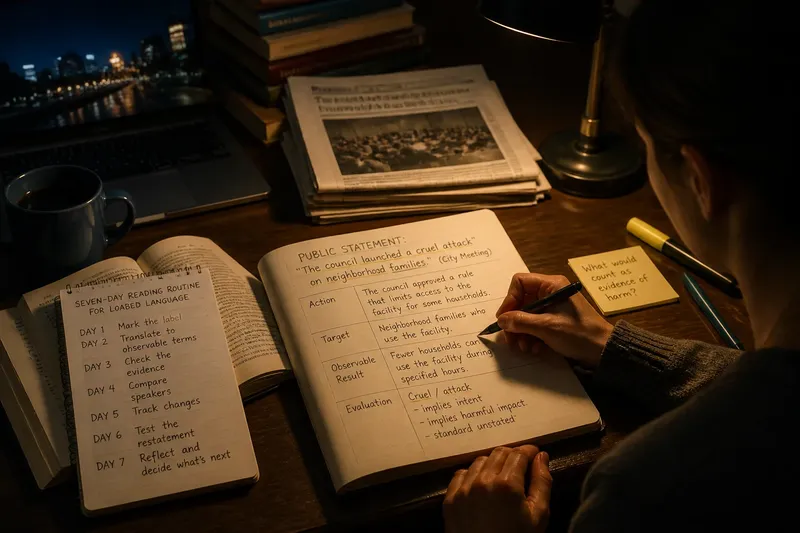
Write each argument as a short chain: claim, supporting reason, connecting premise, conclusion. The connecting premise is often where the real disagreement sits, because it explains why a fact or value should lead to the proposed judgment.
- Claim: What decision does the argument support?
- Reason: What condition, consequence, or right does it emphasize?
- Premise: Why should that reason carry weight here?
- Omission: Which relevant cost, interest, or alternative receives little attention?
- Test: What information or principle would make the argument more convincing?
Say you are reading two statements about the crowded-area rule. One says the rule is needed because access is being blocked; the other says it unfairly limits assembly. You could note that the first depends on whether the blockage is substantial and whether the rule addresses it, while the second depends on how much expression the rule restricts and whether it treats similar groups alike. The notes clarify the disagreement without pretending to resolve facts you have not checked.
This is like comparing two maps of the same neighborhood: each can be accurate while highlighting different routes. The useful question is not which map includes everything, but what each one leaves out that matters for the decision at hand.
How do I tell a strong frame from a selective one?
A strong frame makes its central premise visible and faces the most relevant objection. A selective frame presents one concern as if it settles the issue, while leaving the connection between evidence and conclusion unexplained.
Check the verbs and scope of the claim. Words such as “requires,” “protects,” or “threatens” may point to a conclusion before the supporting reasoning is clear. Then ask whether the argument describes a specific effect or slides from a limited example to a claim about the whole policy.
Also distinguish evidence from value judgments. A statement about who was affected is a claim about events; a statement that the effect is unacceptable expresses a standard. Both may be defensible, but they need different kinds of support.
For claims about legal rights or restrictions, the answer can depend on the relevant law and circumstances. Treat broad public commentary as a starting point, not a substitute for advice from a qualified legal professional where a real decision depends on it.
Which questions help me read competing frames?
Can both frames be partly right?
Yes. A public problem can be real while a response also burdens a right. Recognizing both claims does not decide how they should be balanced; it prevents one concern from being mistaken for the entire issue.
Does a rights frame mean there is no public problem?
No. It asks how a response affects rights and what justification supports the limit. The underlying problem may remain, but its existence alone does not settle which response is appropriate.
Does a problem frame dismiss rights?
Not necessarily. It may focus on effects and practical needs while leaving rights unstated. Look for whether the argument addresses those interests when they are relevant, rather than assuming silence proves deliberate disregard.
What if the arguments use different evidence?
Identify what each piece of evidence can establish and what it cannot. A description of an impact may support the existence of a problem, for example, without showing that a proposed restriction is the only reasonable response.
What should I carry into the next public debate?
When you encounter competing frames, keep the conclusion, evidence, and premise in separate notes. Reading competing frames this way makes it easier to see whether a disagreement concerns what happened, which values should guide a decision, or how those values apply to the case.
That distinction is useful even when the argument remains unresolved. You can describe the disagreement more precisely, identify what would help clarify it, and avoid treating confident wording as a substitute for reasoning. Public debate rarely supplies a neat answer on demand; it can still supply a clearer question.