When a Word Does the Work of a Verdict
Loaded language in public debate can turn description into judgment. Learn to restate claims in observable terms and follow how wording shapes a week.

What does a public statement mean when it calls a proposal “reckless,” “generous,” or “an attack”? Loaded language in public debate can deliver a verdict before you have seen the evidence, the people affected, or the alternatives. The useful response is not to ban forceful words; it is to translate them into claims you can examine.
A label may combine an event, an interpretation, and a judgment about motive or consequence. A seven-day reading routine can separate those layers without turning every news item into a research project. The aim is to identify what is asserted, what would make it observable, and what remains a matter of evaluation.
Start by marking the label, not accepting its verdict
Choose one public issue you encounter in news coverage, a public meeting, or statements from an organization. Keep the subject narrow for the week: perhaps a proposed bus-route change, a school attendance rule, or a city decision about a public space. Write down the exact sentence that caught your attention, including who said it and where it appeared.
Underline the words that seem to judge rather than identify. “Cuts” can literally describe a reduced service or budget, but it may also suggest disregard for people who depend on it. “Reform” can describe a change while presenting that change as an improvement. The same label may be fair in one sentence and slanted in another; its role depends on what the sentence supports.
Before replacing a vivid word with a neutral-sounding one, ask what it invites you to infer. Does it imply that a decision was deliberate, that a group acted selfishly, that a measure will cause harm, or that a change is overdue? Those are separate claims, even when one compact word makes them feel settled.
Translate the sentence into observable terms
On day two, rewrite the sentence so it names an action, an actor, and a stated or observable consequence. Keep the claim close to the available information. If the original says, “The council launched a cruel attack on neighborhood families,” a more inspectable version might be: “The council approved a rule that limits access to the facility for some households.” That wording does not establish whether the rule is cruel; it makes the action and alleged effect easier to check.
A useful restatement avoids both the original judgment and its opposite. “The council made a sensible change” is not a neutral translation of “cruel attack”; it is another verdict. The goal is not to make the sentence bloodless, but to show which part can be verified and which part needs an argument.
Use this structure in your notes:
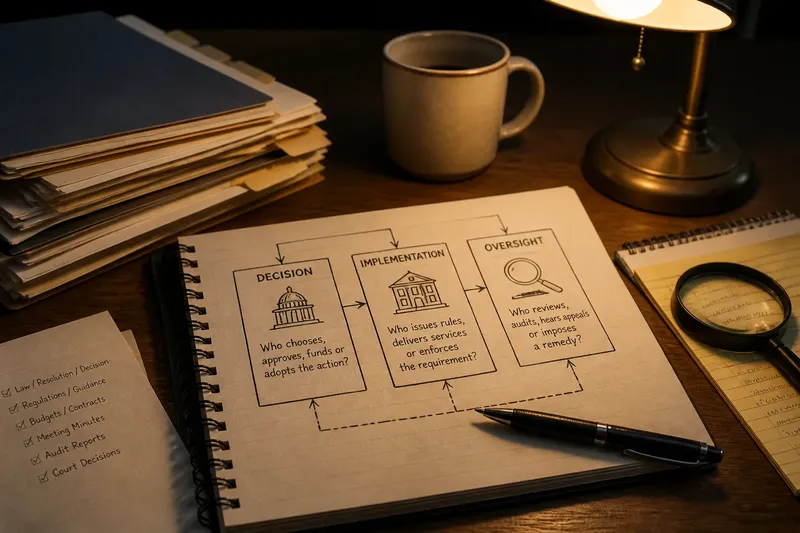
- Action: Identify what a person, agency, company, or group did. If the sentence names no action, then ask what event or decision the speaker is referring to.
- Target: Record who or what is said to be affected. If the target is vague, then note that the speaker needs to specify it.
- Observable result: Name a change you could look for in a rule, record, service, or public statement. If no result is stated, then keep it as an unanswered question rather than supplying one.
- Evaluation: Mark the value judgment, such as fairness, responsibility, or acceptable risk. If the speaker offers a standard for that judgment, then record it; otherwise, note that the standard is unstated.
Keep the distinctions visible. A claim that a rule applies to a group differs from a claim that the rule harms that group. A claim that harm occurred differs from a claim that officials intended it. The extra words are not fussiness; they are where the argument begins.
Check what the label is attached to
On day three, look at the material the speaker uses to support the label. The relevant evidence depends on the claim. Check a written rule against the rule itself; check what happened at a meeting against minutes, a recording, or a direct account. A claim about consequences may need information about the affected service or people, not merely a description of the decision.
Notice when a speaker moves between kinds of claims without saying so. Someone might cite a policy’s wording, then call its effect “devastating,” although the cited text only establishes what the policy says. Another speaker might point to an intended benefit and call the whole measure “responsible,” without addressing who bears its costs. The label does not supply the missing connection.
A label is like a sticker on a storage box: it tells you what someone thinks is inside, but opening the box is still necessary. Here, “opening it” means locating the action or consequence the word stands for, then checking whether the cited material supports that claim.
Compare speakers on day four and track changes on day five
On day four, put two or more descriptions of the same action side by side. Mark what each emphasizes: who acted, who is affected, whether the change is temporary or lasting, and whether the speaker names a consequence or assumes one. The point is not to crown the most neutral sentence; it is to see which details each label highlights and which it leaves out.
Imagine you are following a fictional city proposal to close one entrance to a public library during repairs. One statement calls the change “a needless barrier”; another calls it “a prudent access measure.” Restate the proposal in observable terms: the city plans to close the entrance during repairs and direct visitors to another entrance. Then identify what remains to check, such as the details of the alternate route and who may be affected. The restatement does not decide whether the change is needless or prudent; it identifies what those judgments depend on.
On day five, return to the same issue and record any changes in wording alongside changes in the underlying action. A speaker may first call a proposal “temporary,” then call it “permanent” after officials revise it, or shift from “cost” to “waste” without presenting new information. Note whether the action, the evidence, the label, or some combination changed before treating new wording as evidence that the situation itself changed.
Test the restatement on days six and seven
How can I tell whether a word is loaded?
Ask whether the word identifies something directly observable or evaluates its quality, motive, or moral standing. “The rule removes one option” is more directly checkable than “the rule is punitive,” though the first sentence may still need to specify which option and for whom.
Does neutral wording mean both sides are equally credible?
No. A careful restatement clarifies what each side claims; it does not give those claims equal support. Compare the evidence for each observable assertion, and note when a speaker makes an inference the evidence does not establish.
What if the label is also an accurate description?
Keep it if the speaker explains the standard behind it and the facts support that standard. A rule may define an action as a violation, for instance, while calling the action “shameful” adds a moral judgment readers may assess differently.
How can I preserve a speaker’s meaning without endorsing it?
Attribute the wording and separate it from the restatement: “The group calls the change ‘punitive’; the proposal would remove access to the service for these users.” Attribution shows who made the evaluation, while the second clause gives readers a claim to examine.
On day six, return to the first sentence and write two versions beneath it: the speaker’s original wording and your observable restatement. Add one line naming the evidence you would need to assess the restatement, and another identifying the value judgment that remains. If you cannot identify an observable claim, write that down rather than inventing one.
On day seven, decide whether the label still helps. It may be a concise description supported by specific details, an argument that needs qualification, or a verdict standing in for an argument. For example, imagine your notes began with a fictional statement calling a library entrance closure “punitive.” Your day-six restatement says the city proposes to close one entrance during repairs and direct visitors to another; the available notice confirms the planned closure but says nothing about the alternate route or who may face difficulty using it. On day seven, you can conclude that the proposal and its stated purpose are observable, while “punitive” remains an evaluation unsupported by the notice alone. The unresolved question is not a defect in the exercise; it is a reason to keep the judgment provisional.
This routine also gives you a cleaner way to discuss an issue with someone whose label you reject. Ask what action or consequence the word refers to, then respond to that claim rather than to the emotional force of the label alone. A sound restatement of loaded language leaves room for judgment while showing exactly where judgment begins.